Web browsers
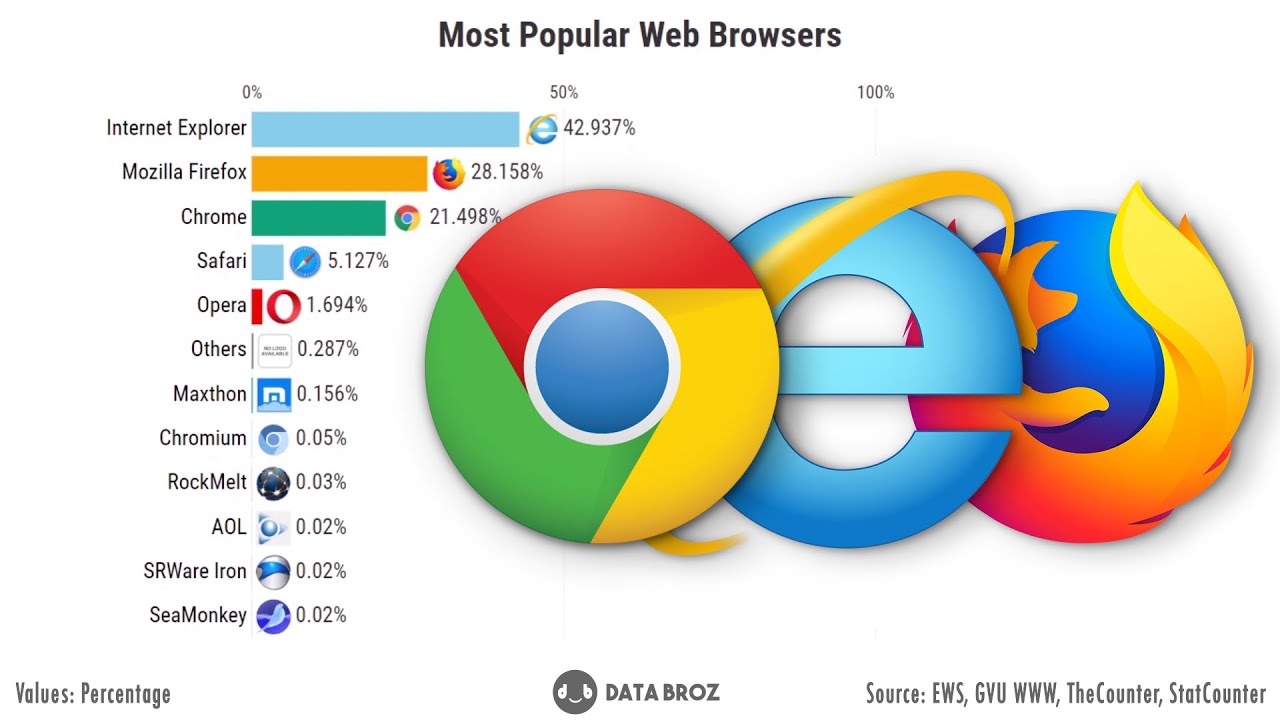
A web browser is application software for accessing websites. When a
user requests a web page from a particular website, the browser
retrieves its files from a web server and then displays the page on
the user's screen. Browsers are used on a range of devices,
including desktops, laptops, tablets, and smartphones. In 2020, an
estimated 4.9 billion people used a browser.
The most used browser is Google Chrome, with a 65% global market
share on all devices, followed by Safari with 18%. A web browser is
not the same thing as a search engine, though the two are often
confused. A search engine is a website that provides links to other
websites.
However, to connect to a website's server and display its web pages,
a user must have a web browser installed. In some technical
contexts, browsers are referred to as user agents. The purpose of a
web browser is to fetch content from the World Wide Web or from
local storage and display it on a user's device. This process begins
when the user inputs a Uniform Resource Locator (URL), such as
https://en.wikipedia.org/, into the browser.
Virtually all URLs are retrieved using the Hypertext Transfer
Protocol (HTTP), a set of rules for the transfer of data. If the URL
uses the secure mode of HTTP (HTTPS), the connection between the
browser and the web server is encrypted for the purposes of
communications security and information privacy.
Google chrome
.svg.png)
Google Chrome is a cross-platform web browser developed by Google.
It was first released in 2008 for Microsoft Windows, built with free
software components from Apple WebKit and Mozilla Firefox. It was
later ported to Linux, macOS, iOS, and Android, where it is the
default browser.
The browser is also the main component of ChromeOS, where it serves
as the platform for web applications. Most of Chrome's source code
comes from Google's free and open-source software project Chromium,
but Chrome is licensed as proprietary freeware.
WebKit was the original rendering engine, but Google eventually
forked it to create the Blink engine; all Chrome variants except iOS
now use Blink. As of October 2022, StatCounter estimates that Chrome
has a 67% worldwide browser market share (after peaking at 72.38% in
November 2018) on personal computers (PC), is most used on tablets
(having surpassed Safari), and is also dominant on smartphones and
at 65% across all platforms combined.
Because of this success, Google has expanded the "Chrome" brand name
to other products: ChromeOS, Chromecast, Chromebook, Chromebit,
Chromebox, and Chromebase.
Firefox

Mozilla Firefox, or simply Firefox, is a free and open-source web
browser developed by the Mozilla Foundation and its subsidiary, the
Mozilla Corporation. It uses the Gecko rendering engine to display
web pages, which implements current and anticipated web standards.
In November 2017, Firefox began incorporating new technology under
the code name Quantum to promote parallelism and a more intuitive
user interface.
Firefox is available for Windows 7 and later versions, macOS, and
Linux. Its unofficial ports are available for various Unix and
Unix-like operating systems, including FreeBSD, OpenBSD, NetBSD,
illumos, and Solaris Unix.
It is also available for Android and iOS. However, as with all other
iOS web browsers, the iOS version uses the WebKit layout engine
instead of Gecko due to platform requirements. An optimized version
is also available on the Amazon Fire TV, as one of the two main
browsers available with Amazon's Silk Browser.
Opera

Opera is a multi-platform web browser developed by its namesake
company Opera. The browser is based on Chromium, but distinguishes
itself from other Chromium-based browsers (Chrome, Edge, etc.)
through its user interface and other features. Opera was initially
released on 10 April 1995, making it one of the oldest desktop web
browsers still actively developed.
It was commercial software for its first ten years and had its own
proprietary layout engine, Presto. In 2013, it switched from the
Presto engine to Chromium. Opera is available on Windows, macOS,
Linux, Android, and iOS (Safari WebKit engine). There are also
mobile versions called Opera Mobile and Opera Mini.
Opera users also have access to Opera News, a news app based on an
AI platform. The company released a gaming-oriented version of the
browser, Opera GX, in 2019, and a blockchain-focused Opera Crypto
Browser into public beta in January 2022.
Microsoft Edge
.svg.png)
Microsoft Edge is a cross-platform web browser created and developed
by Microsoft. It was first released in 2015, bundled with Windows 10
and Xbox One, and later ported to other platforms: Android and iOS,
macOS, older Windows versions (Windows 7 and later), and most
recently Linux. It was created as the successor to Internet Explorer
(IE). Edge was initially built with Microsoft's own proprietary
browser engine EdgeHTML and their Chakra JavaScript engine.
In late 2018, it was announced that Edge would be completely rebuilt
as a Chromium-based browser with Blink and V8 engines. The new Edge
was publicly released in January 2020, and on Xbox platforms in
2021. Microsoft has since terminated security support for the
original browser (now referred to as Microsoft Edge Legacy), and in
Windows 11 it is the default web browser (for compatibility with
Google Chrome).
In May 2022, according to StatCounter, Microsoft Edge became the
second most popular browser in the world, overtaking Apple's Safari
(in some countries, such as the United States, Edge is 3rd most
popular, where Edge has 14% share, slightly behind Safari's 16%
share). As of September 2022, Edge is used by 11 percent of PCs
worldwide.