IGUAZU FALLS
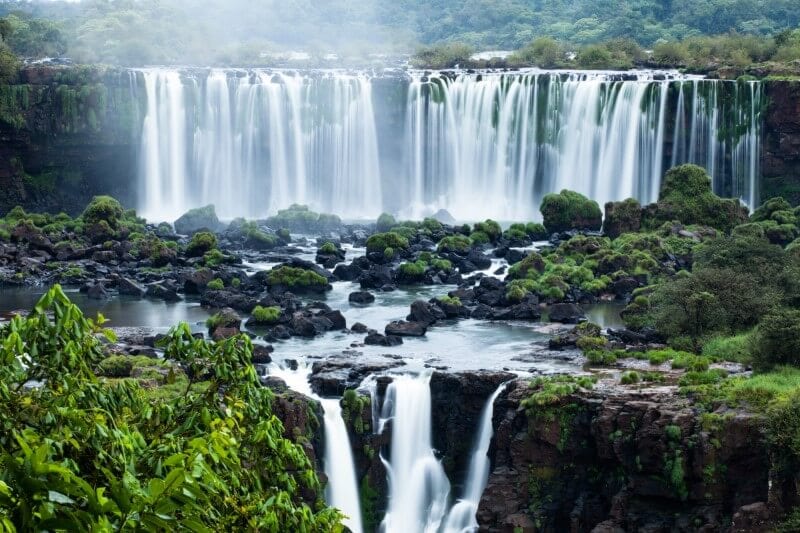
Located in Misiones Province in the Northeastern tip of Argentina and bordering the Brazilian state of Parana to the north, Iguazú National Park, jointly with its sister park Iguaçu in Brazil, is among the world’s visually and acoustically most stunning natural sites for its massive waterfalls. It was inscribed on the World Heritage List in 1984. Across a width of almost three kilometres the Iguazú or Iguaçu River, drops vertically some 80 meters in a series of cataracts. The river, aptly named after the indigenous term for “great water” forms a large bend in the shape of a horseshoe in the heart of the two parks and constitutes the international border between Argentina and Brazil before it flows into the mighty Parana River less than 25 kilometres downriver from the park. Large clouds of spray permanently soak the many river islands and the surrounding riverine forests, creating an extremely humid micro-climate favouring lush and dense sub-tropical vegetation harbouring a diverse fauna.
In addition to its striking natural beauty and the magnificent liaison between land and water Iguazu National Park and the neighbouring property constitute a significant remnant of the Atlantic Forest, one of the most threatened global conservation priorities. This forest biome historically covering large parts of the Brazilian coast and extending into Northern Argentina and Uruguay, as well as Eastern Paraguay, is known for its extreme habitat and species diversity, as well as its high degree of endemism. Around 2000 plant species, including some 80 tree species have been suggested to occur in the property along with around 400 bird species, including the elusive Harpy Eagle. The parks are also home to some several wild cat species and rare species such as the broad-snouted Caiman.
Jointly with contiguous Iguaçu National Park in Brazil, which was inscribed on the World Heritage List in 1986, it constitutes one of the most significant remnants of the so-called Interior Atlantic Forest. Today, the parks are mostly surrounded by a landscape that has been strongly altered due to heavy logging, both historically and into the present, the intensification and expansion of both industrial and small-scale agriculture, plantation forestry for pulp and paper and rural settlements. Jointly, the two sister parks total around 240,000 hectares with this property’s contribution being c. 67,000 hectares.


THE VICTORIA FALLS
As the mighty Zambezi River crashes over a basalt rock ledge and drops 108 metres (354 feet) down into a powerful whirlpool, it forms the largest sheet of falling water on the planet: the Victoria Falls. Traditionally known as Mosi-oa-Tunya (which, aptly, means the 'Smoke that Thunders'), the falling water’s impressive roar can sometimes be heard from 40 kilometres (25 miles) away. And on a wind-free day during high-water season, which runs from about February to July depending on the rain, a dazzling cloud of mist can float high above the Falls. This is truly a magnificent wonder of nature that every safari lover should experience at least once!
Since 1998, we've been planning trips to Victoria Falls in Zimbabwe and Zambia for thousands of travellers from across the globe. Whether you're looking for a lodge beside the Zambezi River amidst trees in Zimbabwe or a grand hotel where white-gloved waiters serve G&Ts on manicured lawns, Vic Falls caters to every style and budget. But knowing when to go and what to expect is important for planning your trip. We’ve compiled all our specialist tips in this handy beginner’s guide to Victoria Falls...
The surrounding environs of jungly rainforest are equally beautiful, creating a magical memory you won't ever forget. The falls are protected in a national park and can be viewed from either the Argentine or Brazilian side.
Iguazu Falls is actually a chain of hundreds of individual waterfalls stretched out almost three kilometers to create the world's largest waterfall on the border between Brazil and Argentina on the Iguazu River. The visual and sound effects of all this water tumbling down some 70 meters is truly like nothing else in the world.
HAVASU FALLS
Havasu Falls is the most beautiful of the five Havasupai Waterfalls that plummet over orange-red cliffs into bright turquoise-blue pools in a side canyon of the Grand Canyon.
The waterfalls are all located on the Havasupai Indian Reservation and can only be accessed via an overnight 10-mile hike that requires advance reservation and payment of fees - no day hiking is allowed, and you must spend at least one night at the campground in the canyon; most people spend three nights.
The number of people allowed into the canyon is limited, and there is often a waiting list to experience this bucket-list worthy waterfall.
Topping the bucket list of bucket lists, Havasu Falls in the Grand Canyon is one of the most sought after destinations in the world. But getting there can be tricky. Here's everything you need to know.
The campground is an area spanning a mile on both sides of Havasu Creek between Havasu Falls and nearby Mooney Falls. There are no assigned sites; meaning, once you arrive, you're welcome to set up camp wherever you like within the designated area.
avasu Falls is remote, so expect a hike with some shade. Bring sunscreen, a hat, a first-aid kit, snacks, and plenty of water. There is no water available on the trail, and it's recommended each person bring at least a gallon for themselves. Trekking poles are optional, although many hikers find these helpful for the steep switchbacks.
Angel Falls
Located in Venezuela, Angels Falls is the world's highest waterfall at a staggering 979 meters or 3,212 feet – this is 15 times higher than Niagara Falls for comparison. The water comes from the Churun River and does a free-fall drop over the edge of a mountain into a set of white water rapids below. There is a second drop of 30 meters just beyond the rapids.
To reach the falls, however, is no easy feat. You'll have to first catch a small plane to the town of Canaima, and then it is a one-day boat ride to the falls
In the heart of the country, where table top mountains rise up like giant monoliths from the surrounding landscape, is Angel Falls. Dropping 979 meters, it is the highest waterfall in the world and one of the highlights of South America..
The best time to see the falls is during the rainy season, between May and November, when water is plentiful and the falls do not disappear into a mist before reaching the bottom as they do in the dry season. During the dry season, the falls may be little more than a trickle and you will want to check in advance to see if there is enough water to make the trip worthwhile.
The campground is an area spanning a mile on both sides of Havasu Creek between Havasu Falls and nearby Mooney Falls. There are no assigned sites; meaning, once you arrive, you're welcome to set up camp wherever you like within the designated area.
The falls are usually visited by either a sightseeing flight or a three-day boat trip beginning in the town of Canaima. The boat trip, which also includes a hike through the jungle to the base of the falls, is not a luxury tour by any stretch, with basic accommodation along the route. The boat trip may not be possible during the dry season due to low water levels in the river.