
History of Geography
Geography (from Greek: γεωγραφία, geographia, literally "earth description") is a field of science devoted to the study of the lands, features, inhabitants, and phenomena of Earth. The first recorded use of the word γεωγραφία was as a title of a book by Greek scholar Eratosthenes (276–194 BC). Geography is an all-encompassing discipline that seeks an understanding of Earth and its human and natural complexities—not merely where objects are, but also how they have changed and come to be. While geography is specific to Earth, many concepts can be applied more broadly to other celestial bodies in the field of planetary science. One such concept, the first law of geography, proposed by Waldo Tobler, is "everything is related to everything else, but near things are more related than distant things." Geography has been called "the world discipline" and "the bridge between the human and the physical sciences".
Geography is a systematic study of the Earth, its features, and phenomena that take place on it. For something to fall into the domain of geography, it generally needs some sort of spatial component that can be placed on a map, such as coordinates, place names, or addresses. This has led to geography being associated with cartography and place names. Although many geographers are trained in toponymy and cartology, this is not their main preoccupation. Geographers study the Earth's spatial and temporal distribution of phenomena, processes, and features as well as the interaction of humans and their environment. Because space and place affect a variety of topics, such as economics, health, climate, plants, and animals, geography is highly interdisciplinary. The interdisciplinary nature of the geographical approach depends on an attentiveness to the relationship between physical and human phenomena and their spatial patterns. Geography is specific to the planet Earth, and other celestial bodies are specified, such as "geography of Mars," or given another name, such as areography in the case of Mars.
Names of places...are not geography...To know by heart a whole gazetteer full of them would not, in itself, constitute anyone a geographer. Geography has higher aims than this: it seeks to classify phenomena (alike of the natural and of the political world, in so far as it treats of the latter), to compare, to generalize, to ascend from effects to causes, and, in doing so, to trace out the laws of nature and to mark their influences upon man. This is 'a description of the world'—that is Geography. In a word, Geography is a Science—a thing not of mere names but of argument and reason, of cause and effect.
Just as all phenomena exist in time and thus have a history, they also exist in space and have a geography.
Geography as a discipline can be split broadly into three main subsidiary fields: human geography, physical geography, and technical geography. The former largely focuses on the built environment and how humans create, view, manage, and influence space. The latter examines the natural environment, and how organisms, climate, soil, water, and landforms produce and interact. The difference between these approaches led to a third field, environmental geography, which combines physical and human geography and concerns the interactions between the environment and humans. Technical geography involves studying and developing the tools and techniques used by geographers, such as remote sensing, cartography, and geographic information system
Geographers

A geographer is a physical scientist, social scientist or humanist whose area of study is geography, the study of Earth's natural environment and human society, including how society and nature interacts. The Greek prefix "geo" means "earth" and the Greek suffix, "graphy," meaning "description," so a geographer is someone who studies the earth. The word "geography" is a Middle French word that is believed to have been first used in 1540.
Although geographers are historically known as people who make maps, map making is actually the field of study of cartography, a subset of geography. Geographers do not study only the details of the natural environment or human society, but they also study the reciprocal relationship between these two. For example, they study how the natural environment contributes to human society and how human society affects the natural environment.
In particular, physical geographers study the natural environment while human geographers study human society and culture. Some geographers are practitioners of GIS (geographic information system) and are often employed by local, state, and federal government agencies as well as in the private sector by environmental and engineering firms.
The paintings by Johannes Vermeer titled The Geographer and The Astronomer are both thought to represent the growing influence and rise in prominence of scientific enquiry in Europe at the time of their painting in 1668–69.
Continents
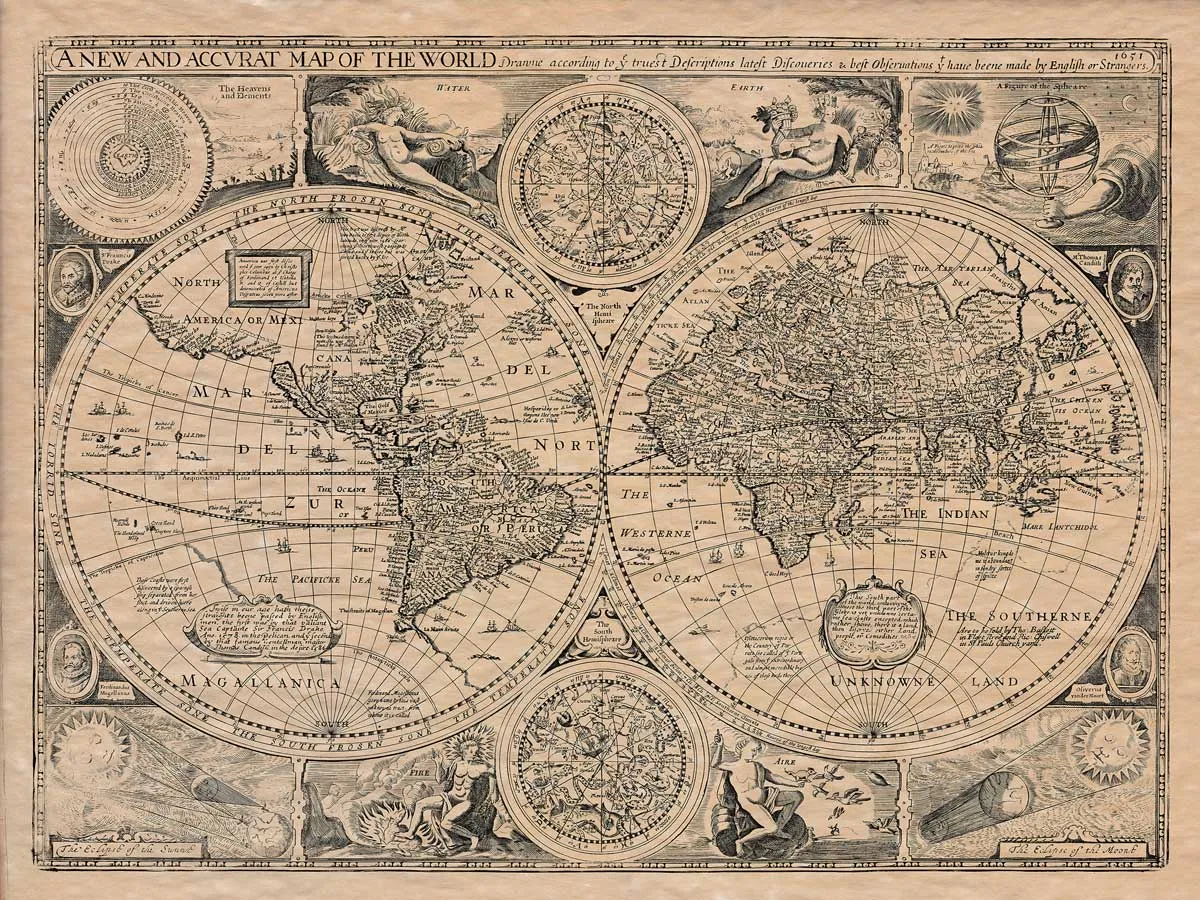
A continent is any of several large landmasses. Generally identified by convention rather than any strict criteria, up to seven geographical regions are commonly regarded as continents. Ordered from largest in area to smallest, these seven regions are: Asia, Africa, North America, South America, Antarctica, Europe, and Australia. Variations with fewer continents may merge some of these, for example America, Eurasia, or Afro-Eurasia are sometimes treated as single continents, which can bring the total number as low as four. Zealandia, a largely submerged mass of continental crust, has also been described as a continent.
Oceanic islands are frequently grouped with a nearby continent to divide all the world's land into geographical regions. Under this scheme, most of the island countries and territories in the Pacific Ocean are grouped together with the continent of Australia to form a geographical region called Oceania.
In geology, a continent is defined as "one of Earth's major landmasses, including both dry land and continental shelves". The geological continents correspond to six large areas of continental crust that are found on the tectonic plates, but exclude small continental fragments such as Madagascar that are generally referred to as microcontinents. Continental crust is only known to exist on Earth.
The idea of continental drift gained recognition in the 20th century. It postulates that the current continents formed from the breaking up of a supercontinent Pangaea that formed hundreds of millions of years ago.